Solana Sniper Bot Explained: Speed, Risks, RPC Latency, and Transaction Landing
Learn how Solana sniper bots work, why speed alone is not enough, and how RPC latency, priority fees, WebSocket streams, and transaction landing affect execution.
A Solana sniper bot is an automated trading tool that monitors Solana activity and submits transactions when specific conditions are met — a new token launch, a liquidity pool event, a price or account change. The goal is usually to react faster than a manual trader. Speed does not remove execution risk, scam risk, or failed transaction risk, and this distinction matters more than most product pages suggest.
This is a neutral explainer of how Solana sniper bots work, what risks they carry, and what infrastructure affects execution quality. It is not a product recommendation or ranking.
What Is a Solana Sniper Bot?
Solana sniper bots typically monitor on-chain events such as new liquidity pools, token launches, account changes, or trading activity, then submit transactions when configured conditions are met. They run continuously, listening for signals across Solana's program logs, account updates, or pool-related activity.
Solana sniper bots come in very different forms — a Telegram interface operated with a few taps, a browser terminal, a self-hosted script, a private system built around custom RPC and indexers. The basic loop is the same: detect an on-chain event, submit a transaction. What differs is execution quality, and the gap between product types is substantial.
Speed is the stated premise, but event detection, data freshness, transaction build time, fee logic, submission path, and confirmation handling can all degrade independently.
How Does a Solana Sniper Bot Work?
The general flow looks like this:
Event detection → filters → transaction build → priority fee and slippage settings → transaction submission → confirmation or failure tracking
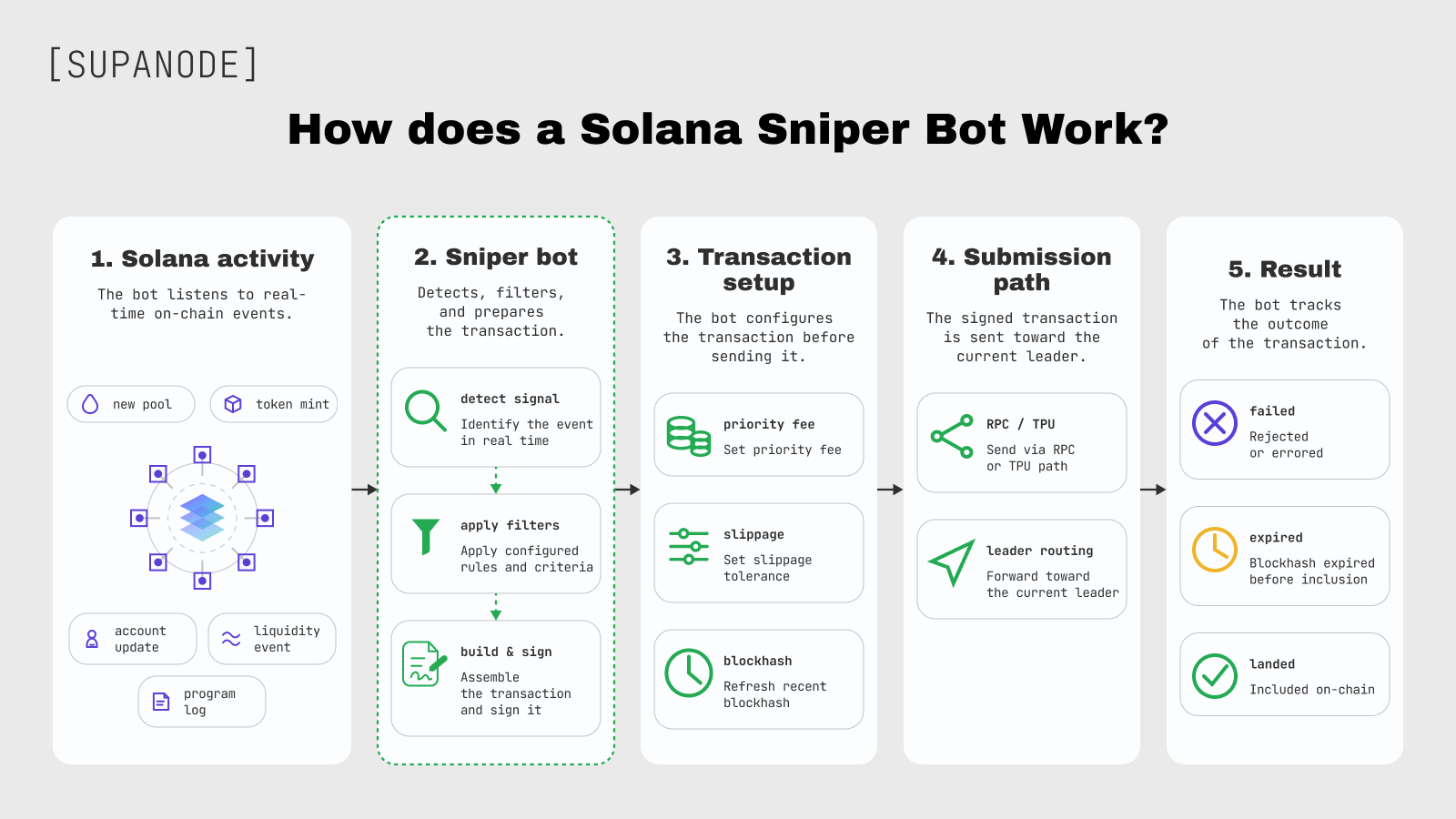
The bot watches for a signal — a new pool, a token mint, a specific program log. It applies whatever filters or rules it has been configured with. It builds a transaction, sets slippage tolerance and a priority fee, signs it, and submits it. Then it waits to see whether the transaction lands, fails, or expires.
Some systems add follow-up logic — sell rules, stop-loss triggers, take-profit conditions. Others stop at the entry.
Solana does not use a classic Ethereum-style public mempool. Transactions are routed toward the current leader through RPC or TPU paths, and event detection means reacting to account updates, program logs, or block data — not reading a pending transaction queue.
Types of Solana Sniper Bots
Telegram Sniper Bots
Telegram-based bots are popular because they are fast to set up and convenient to use from a phone. They typically bundle wallet management, token search, auto-buy and auto-sell, limit orders, copy trading, and DCA into a chat interface. Trojan belongs to this category, alongside several others.
Using a Telegram bot means relying heavily on the provider's infrastructure, wallet model, and security implementation — there is no local execution and no independent verification of what the bot does with a signed transaction.
Web Trading Terminals
Browser-based terminals offer chart views, token discovery, wallet integration, and more visual control over trades. They offer charts, token discovery, and visual control over order parameters. The execution path still depends on the terminal's backend infrastructure.
GitHub and Open-Source Sniper Bots
Open-source sniper bot code exists on GitHub across Python, TypeScript, and similar implementations. Reading it can be useful at the learning stage — it shows how a bot subscribes to program logs, builds a swap transaction, or handles blockhash refresh.
Code on GitHub may be outdated, incomplete, or malicious. Fake repositories designed to steal private keys are not rare in this space. Running any bot code means trusting that code with wallet access. Even well-intentioned open-source projects often lack production-level error handling, RPC fallback logic, or fee estimation — which means they may fail in ways that cost real money.
A GitHub repo can show how a basic sniper bot is structured. Running it against a funded wallet is a different decision.
Private and Custom Sniper Bots
More technical teams sometimes build and operate their own systems. These can integrate custom data feeds, dedicated RPC nodes, gRPC streams, custom indexers, and detailed monitoring. They offer more control but carry higher engineering and security burden, particularly around key management and execution isolation.
Infrastructure-Backed Trading Systems
Systems built for latency-sensitive trading workloads often look nothing like a Telegram bot. They are real-time pipelines with dedicated RPC, streaming infrastructure, priority fee logic, and transaction monitoring built in from the start.
Common Solana Sniper Bot and Trading Bot Examples
The tools below cover the main product types in this space. Wallet model, fee structure, and execution path differ across all of them.
| Tool / product | Common category | Common use case | What to evaluate |
|---|---|---|---|
| Trojan | Telegram / onchain trading bot | Fast buy/sell, sniping, copy trading, limit orders, DCA | Wallet model, fees, automation features, fake clone risk, transaction failure handling |
| BONKbot | Telegram Solana trading bot | Simple fast execution for Solana memecoins | Simplicity, fee model, wallet flow, execution reliability, safety assumptions |
| Maestro | Telegram / multi-chain trading bot | Sniping, copy trading, and limit orders across multiple chains | Chain support, sniping and copy trading features, fee model, wallet and security assumptions |
| Bloom Bot | Telegram + web trading bot | Sniping, copy trading, limit orders, and automation on Solana and EVM | Sniping tools, copy trading, limit orders, automation, wallet and session risk |
| GMGN.AI | Web terminal + Telegram hybrid | Memecoin trading, smart-wallet tracking, and copy trading | Data quality, wallet model, analytics, smart-money tracking, execution path |
| Axiom Trade | Web trading terminal | Token discovery, charting, and trade execution | Token discovery, charts, execution controls, fee model, backend infrastructure |
| Photon Sol | Web trading terminal | Fast Solana token trading through a browser interface | Interface, charting, token discovery, wallet connection, execution assumptions |
| BullX NEO | Web and Telegram hybrid trading platform | Memecoin trading, token screening, and fast execution | Web and Telegram flow, token screening, fee model, execution claims |
| Banana Gun | Telegram / multi-chain sniper bot | Sniping and fast execution across Solana and other chains | Chain support, sniper features, fee model, wallet and security model |
Wallet model, fee structure, execution path, and how each handles failed transactions are more useful evaluation points than name recognition.
What Is Trojan on Solana?
Trojan is a Telegram-first trading interface for Solana. The bot covers fast buy and sell execution, position management, sniping, copy trading, limit orders, DCA, and new-pair discovery — most of what active Solana trading involves, packaged into a single chat flow.
On fees, Trojan's official documentation describes a 1% bot fee deducted during swap routing, charged only on successful transactions, with cashback mechanics and referral-based discounts available. Fee and cashback terms can change, so the current official docs are the right source before assuming any specific rate.
Trojan-generated wallets use encrypted private keys that users can export to external Solana wallets. The docs frame this explicitly as a hot wallet — designed for active trading, not long-term holding. A wallet connected to an automated trading workflow carries a different risk profile than cold storage, even when the user technically controls the keys.
Trojan is also a frequent imitation target. Fake Telegram handles, phishing links, and cloned interfaces designed to drain wallets or extract seed phrases circulate regularly around well-known bot brands. Verify the official channel directly before connecting any wallet.
Are Solana Sniper Bots Profitable?
Solana sniper bots can produce profitable trades, but the data around this market does not support the idea that bots make most traders consistently profitable.
The closest available public data comes from Pump.fun and PumpSwap activity — the Solana memecoin environment where sniper and Telegram bots are most actively used. It is not a perfect proxy for bot-specific PnL, but it is the right market context. CoinGecko's May 2026 analysis of Pump.fun trader wallets shows how unstable the picture has been. From April 2024 through late 2025, profitable wallets rarely exceeded 50% in any given month, and hit a low of around 30% in June 2025. Numbers improved sharply in early 2026 — roughly 57% of active wallets were profitable in February, 70% in March, and 73% in April 2026.
That last figure sounds strong until you look at the distribution. In April 2026, around 65% of all active wallets made between $1 and $500 in realized gains. Only about 5% made more than $1,000. Losses were similarly concentrated in smaller tiers. Even in a relatively strong month, most profitable wallets were generating modest realized returns in a noisy, competitive market.
The methodology also matters. CoinGecko counts only realized PnL, which excludes wallets holding positions that went to zero without ever selling. Bot activity and wash trading are not filtered out. The data is useful, but it likely describes the market as cleaner than it actually is. CoinGecko also notes that the rising profitable-wallet share in 2026 may partly reflect weaker participants leaving — monthly active wallets dropped from around 5.2 million in May 2025 to roughly 1.8 million by December 2025.
There is also a structural problem that speed does not solve. Academic analysis of Solana memecoin launches has found that coordinated accounts can hold a large share of token supply while obscuring real ownership concentration from buyers. In that environment, entering faster may simply mean losing faster on a manipulated launch. The sniper bot puts a trader into the trade earlier — it does not make the trade structurally sound.
Landing rate, confirmation rate, and successful swap rate all describe parts of the execution path. None of them prove the trader made money after slippage, priority fees, bot fees, liquidity changes, token behavior, and exit timing are counted. Speed claims from providers typically describe some portion of execution — not net PnL. Without public methodology, those figures are hard to interpret.
If a strategy has genuine edge, stronger infrastructure can protect it — reducing stale reads, missed events, failed transactions, and weak fee estimation. But infrastructure cannot turn a poor token, weak risk model, or coordinated launch into a good trade.
Are Solana Sniper Bots Safe?
Any sniper bot that can submit transactions from a wallet sits close to the part of the stack that controls funds. The risk profile depends on three things: what the tool controls, what it shows before execution, and how it handles failure.
Wallet model is where evaluation should start. Some bots generate a wallet for the user; others ask for an imported private key; others route through an external wallet interface like Phantom.
Any wallet connected to an automated trading workflow should be treated as a hot wallet: funded only with what the user can afford to lose, and kept separate from longer-term holdings.
Failed execution, expired blockhash, dropped transaction, slippage rejection, and delayed confirmation are different states that require different responses. A bot that collapses all of these into a single "failed" label makes it hard to know whether the problem was execution, network delivery, fee logic, or something upstream. A dropped transaction may need a retry. An expired transaction should not be treated as pending. A transaction that already landed should not be resubmitted. These distinctions matter, especially when users are trading quickly and trusting the interface to reflect reality.
Fee visibility matters too. Priority fees, platform trading fees, slippage tolerance, and whether failed transactions still consume network fees should all be understandable before a user scales up position size. Aggressive slippage defaults or opaque fee structures can turn a working bot into an expensive one.
Popular Telegram trading bots are also frequent imitation targets. Fake handles, cloned interfaces, and phishing links built to look identical to real products are an ongoing problem across the category — not unique to any one product. Verifying the official channel before connecting a wallet is the baseline, not an extra precaution.
Solana Sniper Bot GitHub, Free Bots, and Download Searches
Open-source sniper bot code exists across GitHub, and reading through it can be useful at the learning stage — it shows how a bot subscribes to program logs, builds a swap transaction, or handles blockhash refresh. The structural logic of a simple bot is not hidden.
Most free projects do not get anywhere close to production-ready. Solana's own documentation notes that public RPC endpoints are shared infrastructure not intended for production applications, and that shared endpoints may return rate-limit errors under load. Removing the licensing fee does not remove the need for reliable RPC access, stable event streams, error classification, wallet isolation, monitoring, and maintenance — those requirements remain regardless of what the code costs.
Researchers have documented malicious repositories on GitHub presenting as open-source trading bots with hidden key-stealing logic. Separate analysis has found that fake stars and fake forks are routinely used to make crypto-related repositories look credible before they are reported or taken down. Star count is not a code review.
Before running any open-source bot code against a funded wallet:
- Does the bot ask for a private key or seed phrase? That creates direct wallet exposure regardless of anything else the code does.
- Are dependencies pinned and readable? Malicious packages can be buried inside the dependency tree without touching the main logic.
- Is any part of the code obfuscated? Obfuscation in wallet-facing software is a strong warning sign.
- When was the code last updated? Solana's SDK, RPC behavior, and DEX interfaces change; old code breaks in ways that can cost money silently.
- Does the code distinguish between failed, dropped, expired, and unconfirmed transactions? Without that, users cannot tell what actually happened to their funds.
Best Solana Sniper Bot? The Better Question Is What You Need It for
There is no universal best bot. A name appearing often in comparison articles says nothing about reliability, security, or fit for a specific workload.
It depends on what the user actually needs:
- Beginners are usually better served by understanding risk before choosing a tool. Which bot to use matters less than understanding slippage, failed transactions, wallet exposure, and token quality.
- Active users comparing products will care about wallet model, fee structure, how the bot handles failed transactions, what support looks like, and whether the product has a credible track record.
- Builders and technical teams care about data freshness, RPC quality, stream reliability, transaction submission paths, priority fee logic, and monitoring. For them, the product interface is almost beside the point.
Telegram bot, web terminal, open-source script, or custom infrastructure-backed system — each category involves different tradeoffs around convenience, control, cost, and risk. Which one fits depends on the use case, not the ranking.
Why Speed Matters for Solana Sniper Bots
Speed runs through the entire stack — data freshness, stream reliability, priority fee logic, transaction submission, and confirmation handling. Any layer of that path can become the bottleneck independently.
Sub-100 ms is a number that comes up often in this space. It can mean RPC round-trip, event delivery delay, transaction submission latency, or full signal-to-confirmation time — and those are not the same measurement.
| Speed layer | What it means | What can go wrong |
|---|---|---|
| Event detection | Bot sees a signal on-chain | Missed or delayed event from dropped subscription |
| Data freshness | Bot reads current Solana state | Stale account or pool data |
| Stream reliability | Updates arrive consistently | WebSocket disconnect or reconnect gap |
| Transaction build | Transaction is prepared and signed | Slow signing or invalid state assumptions |
| Priority fee logic | Fee is set appropriately for conditions | Underpay under congestion, or CU limit set too high |
| Submission path | Transaction reaches the leader | RPC lag, dropped request, or routing failure |
| Confirmation tracking | Bot knows the result | Misclassified failed, dropped, or expired transaction |
A sniper bot can detect the right event quickly and still fail if the transaction arrives late, uses stale state, underpays priority fees, expires before landing, or reaches a leader after the market has already moved.
Even advanced guides sometimes describe only 70–80% landing or execution success under specific conditions, which means 20–30% of attempts may still fail before profitability is even considered.
Why RPC Latency Affects Sniper Bot Performance
RPC is how most systems read Solana state and submit transactions. For a sniper bot, RPC quality affects data freshness, subscription stability, transaction submission speed, and the ability to track failures correctly. Latency is one dimension of that — reliability and consistency matter just as much.
Provider benchmarks sometimes report optimized dedicated Solana RPC setups reaching single-digit or sub-10 ms median latency, while public or overloaded endpoints can be much less predictable and may move into tens or hundreds of milliseconds under load.
Average latency is only part of the picture. Predictable reads, stable subscriptions, and a submission path that holds up under congestion matter as much. Rate limits, stale slot data, dropped WebSocket connections, and delayed transaction forwarding all become more likely during busy launch windows — when any of that variance is most costly.
Public RPC can be useful for learning and simple tests. Serious latency-sensitive workloads usually need more predictable data access and submission paths. If the bottleneck is stale reads, slot lag, or slow transaction submission, the next step is evaluating a low-latency Solana RPC setup.
WebSocket, Logs, and Real-Time Event Detection
Bots commonly monitor accounts, programs, logs, or signatures using Solana's WebSocket PubSub interface. Common subscription methods include logsSubscribe, programSubscribe, accountSubscribe, and signatureSubscribe. These push updates to the bot without requiring constant polling, making them a natural fit for event-driven systems.
WebSocket subscriptions are often the first real-time layer for a Solana bot, and for simpler workloads they can be sufficient. The failure modes are worth understanding: a dropped connection during a busy launch event, a delayed reconnect, provider-side limits on concurrent subscriptions, or noisy logs that require filtering — any of these can mean the bot sees an event late or misses it entirely.
When gRPC or Geyser Streams Become Relevant
Geyser is Solana's validator-side plugin interface for streaming data to external systems. Yellowstone gRPC is a common production-accessible path for consuming those streams — account updates, transaction notifications, slot and block data — without polling.
gRPC and Geyser-style streams become relevant when polling or basic WebSocket subscriptions are no longer keeping up — when the system needs a fast, consistent stream of account, transaction, or block updates without gaps. For high-volume monitoring, indexing, fill engines, AMM watchers, and latency-sensitive trading infrastructure, Geyser streams offer a different model than WebSocket subscriptions alone.
Some providers claim that lower-level streaming feeds such as ShredStream or Geyser-based streams can deliver relevant block or transaction data earlier than standard RPC polling or delayed API paths — in some market material expressed in terms of seconds or arriving before data is available through standard endpoints. Whether that advantage applies in a specific workload depends on the provider, region, and setup.
gRPC is a data delivery mechanism — it can reduce dependence on polling and help systems receive relevant updates earlier or more consistently, but transaction landing depends on the submission path, fee logic, and confirmation handling downstream.
Priority Fees, Compute Budget, and Why Transactions Arrive Late
Solana transactions can include a priority fee — a payment to validators that affects how competitively the transaction is scheduled during congestion. The priority fee is based on compute unit price multiplied by the compute unit limit requested for the transaction.
Setting the compute unit limit much higher than the transaction actually needs means overpaying — the priority fee is calculated from the requested limit, not actual compute used. Some Solana documentation and provider guides reference default or maximum compute unit limits around 1.4M per transaction, though the exact values depend on transaction type and current protocol parameters. Setting the priority fee too low during congestion means the transaction may not land in the target block or may be delayed significantly.
getRecentPrioritizationFees can be used as one signal for fee estimation, but account-specific fee conditions matter, and a fee that was appropriate a few seconds ago may be wrong by the time the transaction hits the leader. Fee logic needs to adapt, not stay static.
For a deeper explanation of compute unit price, compute unit limit, and transaction cost mechanics, see our guide to Solana priority fees.
For sniper workloads specifically: a bot may detect the right event, build the right transaction, and still lose the race if its fee logic is too weak for current network conditions. Priority fee is one part of transaction landing, not a guarantee of it.
Transaction Landing: Why a Sniper Bot Can Detect the Right Event and Still Fail
Most failure modes in a sniper bot's execution path sit between detection and confirmed execution, not in the detection logic itself.
Solana routes transactions toward the current leader through RPC or TPU paths. An RPC node may retry or rebroadcast a transaction, but delivery is not guaranteed. The blockhash attached to a transaction is valid for a limited window — roughly 150 blocks, typically around 60–90 seconds depending on slot timing. After that window, the transaction is invalid regardless of whether it ever reached a leader.
| Failure type | What happens |
|---|---|
| Stale data | Bot acts on state that already changed |
| Late submission | Transaction reaches the leader path too late |
| Low priority fee | Transaction is less competitive during congestion |
| Expired blockhash | Transaction becomes invalid before landing |
| Slippage failure | Price or liquidity changes before execution |
| Account contention | Same accounts are heavily contested by multiple transactions |
| RPC lag | Reads or submissions are delayed |
| Subscription drop | Bot misses or delays event detection |
| Bad confirmation logic | Bot cannot classify landed, failed, dropped, or expired state correctly |
Account contention comes from write locks, congestion, and competing transactions hitting the same accounts in the same block — the failure rate for any individual transaction rises sharply when a launch attracts heavy simultaneous activity.
Confirmation logic is also often underbuilt. A bot that submits a transaction needs to correctly classify the outcome: landed, failed on-chain, expired, or dropped before reaching a leader. Each of these requires different handling, and misclassifying a dropped transaction as confirmed — or retrying an already-landed one — can compound the problem.
Across early bot implementations, confirmation logic and fee estimation tend to be underbuilt — not the detection layer, which gets the most attention but is rarely where execution breaks.
For a broader breakdown of trading workloads beyond sniping, the Solana trading bot infrastructure guide covers the architecture in more depth.
Public RPC vs Shared RPC vs Dedicated Infrastructure
| Setup | Good for | Weakness for sniper workloads |
|---|---|---|
| Public RPC | Learning, simple tests, basic reads | Rate limits, lag, no guarantees, unstable subscriptions |
| Shared paid RPC | Early bots, prototypes, lower-cost apps | Quotas, noisy neighbors, limited control |
| Dedicated RPC | Serious workloads needing stable reads and submission | Higher cost, provider quality matters |
| gRPC / Geyser stream | Real-time high-volume monitoring | More complex, requires engineering |
| Self-hosted infrastructure | Maximum control | Expensive, operationally heavy |
At production scale, public RPC tends to be the first thing that limits reliable execution — not just latency, but subscription stability, rebroadcast behavior, and the ability to correctly track what happens to every transaction. For a broader breakdown of trading workload architecture, read the Solana trading bot infrastructure guide.
What Infrastructure Does a Serious Solana Sniper Workload Need?
| Area | What to evaluate |
|---|---|
| Data freshness | Is the system reading current state or stale state? |
| Event stream | Can it detect relevant logs, accounts, and program updates reliably? |
| RPC quality | Are reads and submissions stable under load? |
| Fee logic | Does it adapt to priority fee conditions? |
| Blockhash handling | Does it avoid expired transactions? |
| Confirmation logic | Can it classify landed, failed, dropped, and expired transactions? |
| Security | Are keys isolated and protected? |
| Monitoring | Are latency, failures, retries, and dropped streams measured? |
| Indexing | Can the system query historical or account-level state efficiently? |
Each of these areas can fail independently and in combination. Strong stream delivery paired with weak fee logic still produces poor landing consistency. Missing confirmation classification makes failure diagnosis guesswork regardless of what else is working.
A serious high-speed trading workload needs more predictable infrastructure than public RPC can provide — not just for speed, but for the ability to read fresh state, maintain stable streams, and correctly classify what happens to every transaction submitted. For a broader breakdown of trading workload architecture, read the Solana trading bot infrastructure guide.
Conclusion
A sniper bot that detects the right event is not the same as one that executes it reliably. Speed is a property of the full path — data freshness, stream stability, fee logic, submission routing, and confirmation handling — and any layer of that path can become the bottleneck before strategy logic ever matters.
The Solana trading bot infrastructure guide covers the broader architecture in more depth.