How to Mine Solana: What "Solana Mining" Actually Means
Learn why native SOL cannot be mined, how Solana staking and validators differ from Bitcoin mining, and where ORE mining fits into the confusion.
A lot of the confusion around Solana mining starts with one reasonable assumption: if Bitcoin can be mined, Solana probably can too. But once you look closer, the phrase “Solana mining” usually ends up mixing together three different things: native SOL, staking rewards, and separate Solana-based protocols like ORE that use mining-like language without being part of Solana consensus.
The mechanism that drives everything else here is Proof of Work versus Proof of Stake.
Why Bitcoin Has Mining and Solana Does Not
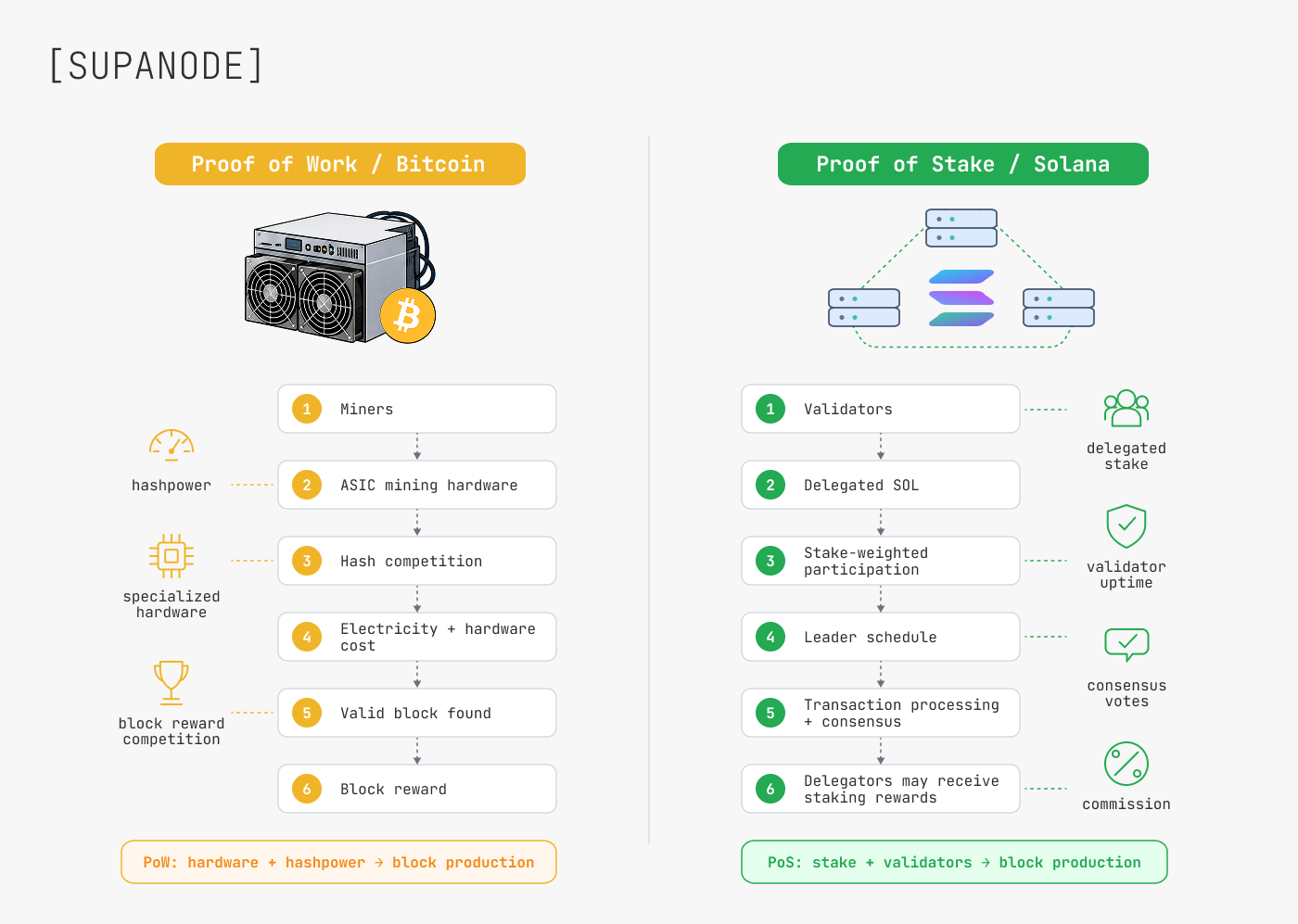
Mining is a Proof of Work mechanism. Bitcoin miners run specialized hardware — ASICs, GPUs — that burns electricity competing to solve cryptographic puzzles. The first miner to solve each puzzle produces a block and earns newly created coins. That competition is what secures the network and what creates new Bitcoin.
Solana works through stake. Validators participate based on how much SOL is delegated to them — that is what determines their weight in the network. Block production follows a stake-weighted leader schedule. Validators coordinate rather than compete, which is part of why the network can process transactions at the speed it does. Introducing a hardware race would break that model.
| Mechanism | Proof of Work | Proof of Stake |
|---|---|---|
| Network participants | Miners | Validators |
| Main resource | Hashpower, electricity, hardware | Staked tokens / delegated stake |
| Block production logic | Compute-based competition | Stake-weighted validator participation |
| Native mining | Yes | No |
| Typical user action | Join mining pool / run mining hardware | Delegate stake / run validator |
| Example | Bitcoin | Solana |
Mining in Bitcoin does several things at once. It decides who gets to add the next block, makes attacks expensive by forcing miners to spend real-world resources, and creates new BTC as part of the block reward. The hardware race is not a side effect — it is the mechanism. Solana separates this differently. Validators are scheduled and weighted through stake. More delegated stake increases a validator's role in the network, and better infrastructure helps the validator stay online and perform reliably, but there is no hash target to beat and no native SOL reward for running consumer hardware.
Mining terminology comes from Bitcoin. Solana was built on a different model from the start, so the word simply does not have an equivalent here.
Solana Proof of History Is Not a Mining Algorithm
Proof of History is Solana's way of keeping a verifiable sequence of events. Validators use it to agree on transaction order quickly, without waiting on external timestamps — that is a big part of where Solana's throughput comes from.
The confusing part is that PoH does involve computation. It creates a verifiable sequence that lets the network prove one event happened before another, which can sound close to mining if Bitcoin is the only comparison point. The difference is what the computation is for. In Bitcoin, computation is the competition — miners spend hashpower to win the right to produce a block. In Solana, Proof of History helps validators keep a shared order of events, but it is not an open competition where users earn SOL by contributing more hardware. A normal user cannot run PoH from a laptop or phone and receive SOL for it.
The security model is still Proof of Stake: validators, delegated stake, rewards. PoH supports that system. It does not replace mining with a different user-facing earning process.
What Replaces Mining on Solana: Validators and Staking
SOL holders participate in the network through staking. Delegation works like this: a holder assigns their SOL to a validator, the validator processes transactions and participates in consensus, and the delegator receives a share of whatever rewards flow to that validator.
Those rewards vary. A few things determine what delegators actually get:
- Rewards depend on validator performance, commission rate, network parameters, and market conditions — they are variable and not guaranteed
- Commission is the cut a validator takes before distributing the remainder to delegators
- Simply holding SOL in a wallet does not generate staking rewards; the SOL needs to be actively delegated, either directly or through a staking service that does it on your behalf
- Validator uptime matters — underperformance means missed rewards for both the validator and its delegators
On risk: the main practical concerns for delegators are validator underperformance, commission changes, custodial risk if staking through a third-party platform, and SOL price volatility.
One thing worth clarifying about native staking: delegation does not mean transferring SOL to the validator's wallet. The stake is assigned to a validator so it counts toward that validator's weight in the network. The validator cannot spend the delegator's SOL.
The validator's job is operational — stay online, vote correctly, process transactions, participate in consensus. Delegators choose validators based on performance, commission, track record, and their own risk tolerance. A validator with poor uptime can miss rewards. A higher commission means a smaller share reaches delegators. A custodial staking service adds platform risk on top of all of that. None of this resembles Bitcoin mining economics, where the core question is hardware cost, electricity, pool fees, and hash rate.
For more detail on how delegation and rewards work, see our guide to [Solana staking rewards] and [how Solana validators work].
Solana Mining Apps and Device-Based Mining Claims
Solana has no native SOL mining process, so the device does not matter. A GPU, phone, APK, or Telegram bot cannot mine SOL because there is nothing to run.
The useful way to classify any "Solana mining" app is by mechanism, not by device. If it asks to delegate SOL to a validator, it is staking. If it distributes test tokens, it is a faucet. If it interacts with ORE, it is ORE's own protocol. If it mines another asset and pays out in SOL, then SOL is the payout currency, not the mined asset. If it cannot explain where rewards come from or why it needs wallet access, that matters more than what the app is called.
ORE Mining on Solana vs Native SOL Mining
ORE is a separate token and protocol built on Solana — sometimes referred to as "ORE crypto" in searches, though that just means the ORE token and its protocol, not native Solana mining. It uses mining-like language and runs on the same network, which is why it gets pulled into "Solana mining" conversations — but what gets mined is ORE, not SOL, and ORE mining is not part of Solana consensus.
ORE v2 is better understood as a separate onchain protocol with its own token distribution mechanics. Current ORE v2 materials describe a grid-based system where users deploy SOL into a 5x5 grid, rounds resolve roughly every minute, and ORE rewards are distributed according to ORE's own rules. That may be called mining inside the ORE ecosystem, but it does not secure Solana, does not create native SOL, and does not replace Solana staking.
The risk profiles are also different. With staking, the main questions are validator performance, commission, custody, and SOL price exposure. With ORE, the questions shift to protocol mechanics, current rules, ORE market price, liquidity, and version changes — ORE has changed substantially across versions, and what applied to v1 does not necessarily apply to v2. The fact that both happen on Solana does not make them the same economic activity.
Any serious engagement with ORE should be checked against current official ORE documentation rather than older guides or third-party token pages.
SOL Mining vs Staking vs ORE vs Everything Else
| Term | What it actually means | Does it mine native SOL? | Main caveat |
|---|---|---|---|
| SOL mining | Usually a misconception based on Bitcoin-style mining | No | No such native process exists |
| SOL staking | Delegating SOL to validators | No | Rewards vary; validator performance and commission matter |
| Running a validator | Operating Solana network infrastructure | No | Requires technical operations, uptime, hardware, and maintenance |
| ORE mining | Interacting with a separate Solana-based ORE protocol/token | No | ORE mechanics and rules can change |
| Faucet SOL | Devnet/testnet tokens for development | No | Not mainnet income |
| Solana mining app | Third-party app claiming mining rewards | No direct native SOL mining | Often misleading or high-risk |
Solana Mining Profitability: Staking, Validators, and ORE
For native SOL, there is no mining profitability calculation — no hash rate, no mining pool, no electricity break-even point, no hardware to optimize. The phrase only makes sense if it is being used loosely to mean something else.
The real calculations are separate. For staking, the question is expected yield after validator commission, adjusted for validator performance and SOL price. For running a validator, the question is whether rewards and commission can cover infrastructure, maintenance, voting costs, and operational work over time. For ORE, the calculation is different again: protocol mechanics, ORE market price, participation costs, liquidity, and version-specific rules that have changed between v1 and v2.
Staking is not mining. Validator operations are not mining. ORE is not SOL. The profitability question only becomes answerable once the activity is named correctly.
How to Evaluate "Solana Mining" Claims
For any Solana mining claim, the question worth asking first is: what exactly is being earned, and where does it come from?
If a service says it mines native SOL directly, that does not match how Solana works. The more productive questions are whether the app is actually distributing ORE or another token, whether this is a reward or points program that pays out in SOL as an incentive, what the service is asking the user to trust, and whether there is a clear explanation of the underlying mechanism.
Claims worth treating carefully:
- Guaranteed daily SOL or fixed returns
- Telegram mining bots for Solana
- Cloud mining SOL
- APK downloads for Solana mining
- Deposit SOL to activate mining rewards
- Connect wallet to unlock earning
- Any request for a seed phrase or private key
- No explanation of what is actually being mined or farmed
Basic evaluation checklist:
- Never share a seed phrase or private key with any app or service
- Check whether the app is distributing native SOL, another token, devnet tokens, or points
- Verify claims against official Solana documentation
- Be cautious about upfront deposit requirements framed as activation fees
- If the mechanism is not explained clearly, that is a reasonable reason to stop.
Devnet and testnet faucets are a different category entirely — they distribute test tokens for developers building on Solana, not mainnet SOL and not an income mechanism. How to mine Solana for free usually leads people toward faucet content or misleading app claims; neither is a path to mainnet SOL.
Practical Paths Depending on What You Actually Want
For native SOL participation in network rewards: staking and validators. Delegate SOL to a validator directly or through a staking service, understand the commission structure, and track validator performance.
For development and testing: official Solana devnet and testnet faucets provide test tokens. These are not mainnet SOL.
For ORE: treat it as a separate protocol with its own mechanics, verify the current state through official ORE sources before interacting with it, and do not carry assumptions from older ORE guides forward.
For understanding Solana's architecture: validators, leader schedules, PoH ordering, and how stake-weighted participation works are all covered in more detail in the Solana consensus and Proof of History guide.