The Fastest Solana TPU Sender in Our Frankfurt Race
See how Supanode TPU Sender performed against Astralane and Helius in a 500-probe Frankfurt transaction race.
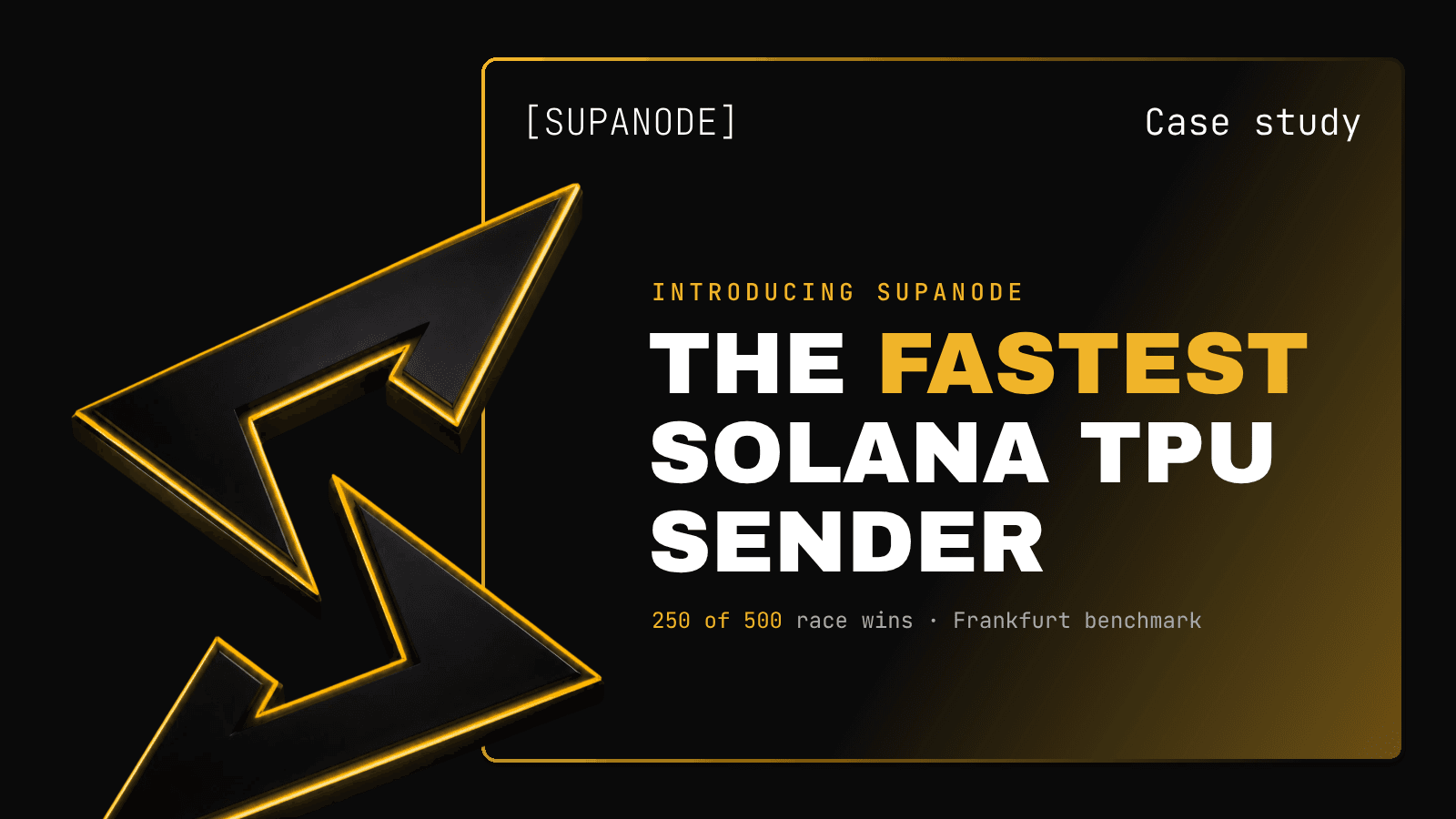
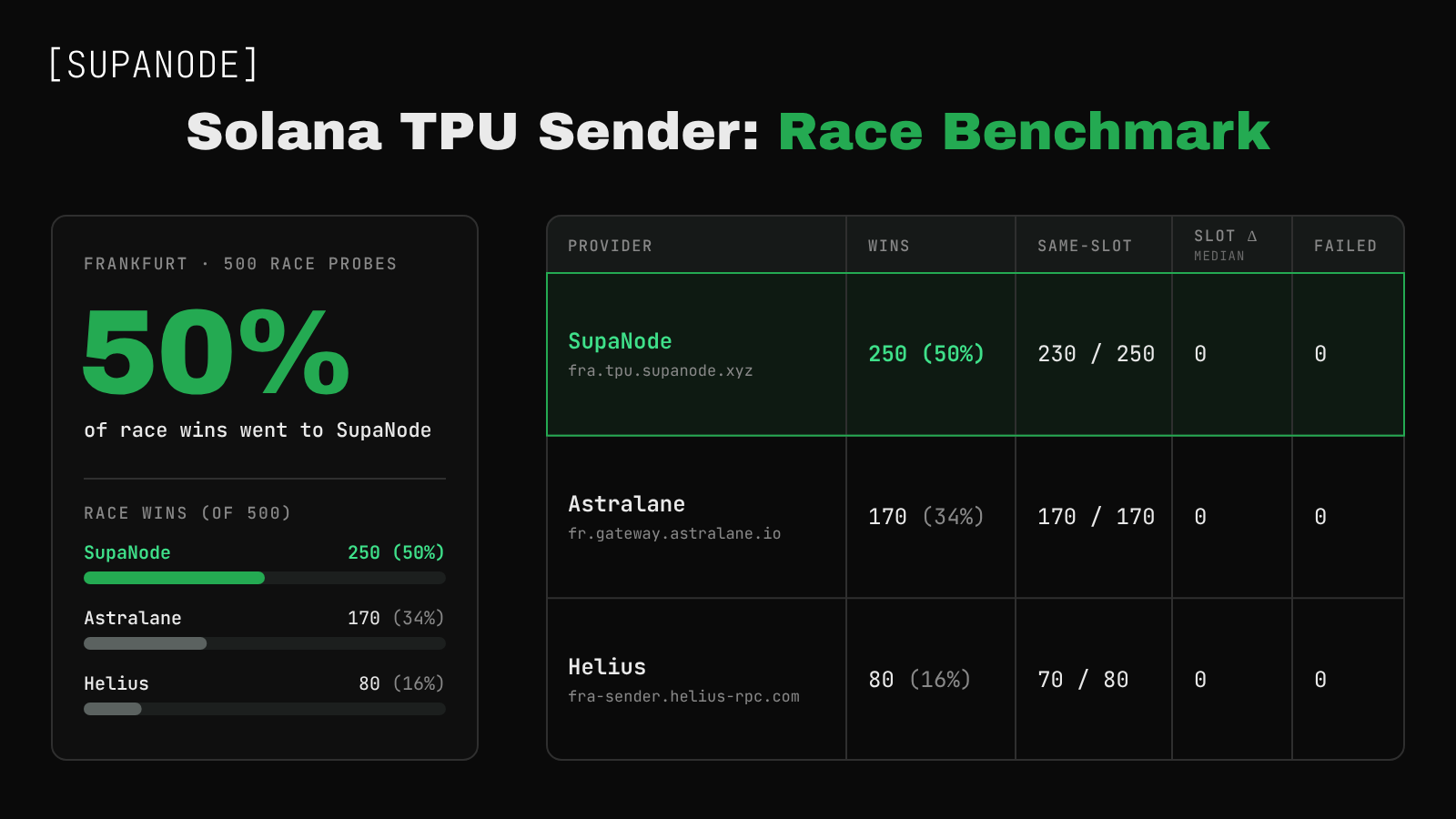
We launched Supanode TPU Sender and raced it against Astralane and Helius on their Frankfurt endpoints. In our 500-probe benchmark, Supanode won 250 races, Astralane 170 and Helius 80.
For latency-sensitive trading applications, when a transaction lands can affect its execution order and the state it executes against. We used a shared Pump.fun signal to compare the three sender routes under the same test settings.
What we built
Supanode TPU Sender is a dedicated submission path for transactions your application has already built and signed. It sits between transaction signing and delivery to the scheduled leaders. Your application hands over the serialized transaction, and the sender forwards it toward the current and upcoming Solana leaders.
Everything that defines the transaction stays in your code: the instructions, the priority fee, the compute-budget limits, the blockhash and the signature. The sender delivers those signed bytes unchanged.
For a successful JSON-RPC submission, the sender returns the transaction signature. That response acknowledges acceptance and nothing more. You track inclusion and confirmation separately through RPC, checking the execution result and following the signature until it reaches the commitment level your application acts on, whether that's processed, confirmed or finalized.
Retries stay under your application's control too. The sender doesn't resend accepted transactions on a schedule, and if the same signature comes in again shortly after the first attempt, the sender may accept it without sending it again. Your application decides when another attempt is worth making. It tracks the lastValidBlockHeight returned with the blockhash, and when it needs a fresh blockhash, it rebuilds and re-signs the transaction. The full loop is described under retransmission and blockhash expiry.
Trading applications commonly use RPC for state queries, subscriptions, transaction history and confirmation. A sender has a narrower job: moving a signed transaction toward the leader through stake-backed and block-engine routes. You can keep your existing RPC setup for reads and status checks and send signed transactions to a separate endpoint.
Where the transaction goes
Transaction forwarding may involve the following validators, block engines and simulation infrastructure:
We send to upcoming leaders and may also use their block engines: Jito (BAM), Jito (DBI), Harmonic, Everstake or GBX. If you request preflight with skipPreflight: false, we also send to our RPC infrastructure provider for simulation. Third-party validators and engines handle transactions under their own rules, which can include sharing with block builders; we don't control them.
The direct, validator-facing path forwards each accepted transaction to upcoming leaders over stake-weighted QUIC. Solana leaders typically hold four consecutive slots, and the current mainnet target is 200 ms per slot, so the sender targets the validators scheduled for the next blocks rather than one fixed destination.
According to the routing documentation, the sender has no mempool. It delivers to those upcoming validators, to the block engines listed above and, when preflight is requested, to the simulation provider.
Block-engine routing depends on the upcoming leader and the sender's current route configuration. The same documentation notes that block-engine submission can include placing the transaction in a bundle with a Supanode transaction. The API response doesn't tell you which internal path carried a given transaction.
Preflight is off by default. With skipPreflight: false, simulation runs at Supanode's RPC infrastructure provider before the transaction is dispatched.
Stake-weighted QoS applies at leader ingress. The leader ties each QUIC connection to stake, and when ingress is contended, stake-weighted connections get a larger share of capacity based on their assigned stake.
After ingress, scheduling and execution decide how the leader handles the transaction. The scheduler orders transactions by fee relative to estimated cost and is limited by write-lock contention on hot accounts. Execution depends on the transaction's validity and its compute limits. Confirmation then follows as cluster commitment, which your application observes through RPC.
When landing results shift, these stages help you investigate possible causes. For arrival timing, look at the delivery path and region. For ordering among admitted transactions, look at fee and compute settings. If an included transaction returns an error, inspect the error and logs, including program, account and compute-limit errors. The Frankfurt benchmark compares the resulting on-chain inclusion order across sender routes.
How we ran the Frankfurt race
Each probe followed the same sequence:
- We pick a Pump.fun transaction as the signal.
- We prepare a reaction transaction for the probe, and each of the three senders receives its own signed copy at the same time.
- Only one copy can execute. Once the first copy lands, the others can no longer go through.
- We identify the winning sender by the hash of the landed transaction.
- We measure the distance between the winning copy and the signal in slots and in transactions.
Anchoring each probe to an observed Pump.fun transaction lets us measure where the reaction landed relative to a specific on-chain signal. The reaction can't be sent until the signal appears. Slot and transaction distance show its position relative to that signal; they do not measure elapsed time in milliseconds.
We matched submission parameters so the three sender paths could be compared under the same workload. All copies carried identical fees, and ping to the three Frankfurt endpoints was equal under the test conditions. The resulting inclusion order reflects how each sender path performed under that shared configuration.
Attribution works at the sender level. We identified the winning sender using the transaction hash, the record of which transaction was sent to each sender, and the tip recipient visible in the landed transaction. The benchmark credits Supanode TPU Sender as a whole, which is what an application gets when it submits to the endpoint.
Frankfurt race, 500 probes
| Sender | Endpoint | Race wins | Win share | Same-slot among wins | Failed |
|---|---|---|---|---|---|
| Supanode | fra.tpu.supanode.xyz | 250 / 500 | 50% | 230 / 250 (92%) | 0 |
| Astralane | fr.gateway.astralane.io | 170 / 500 | 34% | 170 / 170 (100%) | 0 |
| Helius | fra-sender.helius-rpc.com | 80 / 500 | 16% | 70 / 80 (87.5%) | 0 |
Same-slot means the winning copy landed in the same slot as the Pump.fun signal. Every transaction in the test went through without errors, and every probe produced exactly one winner: 250 + 170 + 80 = 500.
Reading the numbers
Supanode won 250 of the 500 races, as many as Astralane and Helius combined and 80 more than the next sender. Because only one copy executes per probe, win share counts how often each sender delivered the transaction that decided the probe. Supanode delivered it in half of all races.
The same-slot column shows how close each sender's wins landed to the signal. Watch the denominators here: the same-slot rate divides by each sender's own wins, while win share divides by all 500 probes. Of Supanode's 250 wins, 230 landed in the signal slot. That's 92% of its wins and 46% of all probes. All 170 Astralane wins were same-slot, or 34% of the full sample. Helius landed 70 of its 80 wins in the signal slot, 14% of all probes.
In absolute numbers, that's 230 same-slot wins for Supanode, 170 for Astralane and 70 for Helius, so Supanode's same-slot wins alone outnumber all of Astralane's wins. Supanode's remaining 20 wins came in later slots, as did 10 of Helius's.
Across the whole sample, 470 of the 500 winning transactions landed in the signal's slot. This shows where the winners landed, but not their exact arrival times or when the other routes arrived. Slot distance cannot show how early a transaction landed within a slot. Transaction distance counts the transactions between the signal and the winning copy, giving a more detailed view of their order within the block. For a reaction strategy, that count shows how much on-chain activity came between the signal and the reaction. Whether that activity affects execution depends on which accounts and programs those transactions touched.
Connecting to Supanode TPU Sender
The integration sits after your signing step:
- Build the transaction and include the required tip transfer before signing, or use a declared tip if it is enabled for your key.
- Sign and submit the serialized transaction to the Supanode endpoint for your region, using your Supanode API key.
- Check inclusion and confirmation status through your existing Solana RPC.
- Keep retry and expiry handling in your application.
You can keep your existing RPC for blockhash retrieval, simulation, fee estimation and status tracking, while routing signed transactions through Supanode TPU Sender. Configure your API key and the required tip, and keep retry and expiry handling in your application. Choose a sender region based on measured latency from your application servers and the available regional endpoints.
If you need several transactions to execute in a set order, sendBundle takes one to four of them. According to the documentation, bundles go to block engines only, and Supanode may add its own transaction to the bundle. The sender documentation covers request format, regions, tips, preflight options and bundle handling.